
Posted By: Paul | GRE | 9 Comments
Today’s article will focus on studying for the GRE on your own.
Not all physician assistant programs require the GRE for admission, but if you are applying to one or more that do, maximizing your score through good GRE preparation is crucial. For me, the GRE felt like another hoop I needed to jump through to become a PA - a flaming hoop that hovered six feet off the ground. But hopefully this article will get you started on your own flaming hoop jump.
First, I’ll briefly discuss the advantages and disadvantages of the do-it-yourself approach to GRE study. Next, I will share some guidelines for self-study, and finally, I’ll share some of the reputable GRE self study resources, along with my opinions on them.
Before you commit to doing it on your own, make sure you consider the following factors - self-study isn’t for everyone. Be honest with yourself about whether or not it’s best for you.
If you are a disciplined student who feels confident and has no areas of huge weakness, you’re probably okay to study on your own. If you need more structure and/or guidance, you probably should consider a GRE class or tutor.
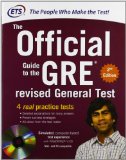
 Though not my favorite, I consider this one essential. Printed by the Educational Testing Service - the very same company that makes the GRE, The Official Guide to the GRE Revised General Test is a must-have. It will familiarize you with the test by showing you how it is organized and scored. It also claims to provide some test-taking strategies, but they are basic at best (they aren’t motivated to make the GRE easy for you - that would cost them money!)
The reason to get this book is that its questions come from actual (retired) GRE tests, so you get a sense for what the real thing will really feel like. This is a good way to decide what areas might be hard for you. It contains 4 practice tests - two traditional hard copy ones, and two on the computer via Powerprep II software - which by itself is a good reason to have it.
Princeton Review’s Cracking the GRE 2014 offers great test taking strategy, particularly for the verbal section. Princeton Review has long focused on a combination of 1) teaching the tested material (i.e. permutations, fractions, etc.) along with 2) the strategies relating to the test itself (i.e. how to attack Sentence Equivalence questions and Quantitative Comparison type questions). The book also provides you with 4 practice tests and access to online tutorials. In terms of the math section, this book is not the best - it will get you ready for the basics, but not so much for the harder math questions.
 Kaplan’s GRE Premier 2014 is somewhat the opposite of Princeton Review. The strength of this book is math. Kaplan books usually use more paper to reduce the noise on the page and walk you through the concepts step by step. This helps you clear your mind to take in the concepts. This is particularly helpful for math prep and it will help you build your confidence. Kaplan’s verbal reasoning tips are more basic, and less helpful. The book contains one full length GRE on paper to assess your strengths and weaknesses, and 5 computer adaptive tests, similar to the real thing. You also have online access to more questions.
 Barron’s GRE comes with plenty of practice problems (like all the others), only their problems tend to be better, and by better, I mean more representative of the actual GRE. They provide many test taking strategies - so many, in fact, that the reader can become a little overwhelmed. The formatting on this book isn’t great - it’s busy. The math can be challenging, which is excellent if you’re ready to tackle the harder math questions, but it can be overwhelming for those who are rusty. Perhaps the biggest drawback for Barron’s is its lack of explanation for practice test questions. What’s that about? [sound of crickets chirping…]
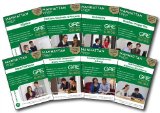 Though a bigger investment, Manhattan GRE Prep’s Set of 8 Strategy Guides is my favorite. It’s a little unfair to compare it to Kaplan/Princeton Review/Barron’s, since it’s a set of 8 different books, each focusing on a separate topic. The math bo0k topics are: 1) Algebra 2) Fractions, Decimals, and Percents 3) Geometry 4) Number Properties 5) Word Problems 6) Quantitative Comparisons and Data Interpretation Guide. The verbal book topics are: 1) Text Completion and Sentence Equivalence Guide, and 2) Reading Comprehension and Essay Guide. The guides are clear, concise, and uncluttered. The problems are similar in difficulty to the GRE, as opposed to easier in an. The Manhattan group seems to understand that what truly builds a good GRE score is not confidence, so much as knowing what to expect (even if it’s hard!) and being prepared for it. Best of all, the set teaches concepts one at a time, and provides plenty of practice problems for that concept before going on to the next. This is unique among GRE prep materials, which usually share one or more concepts, explain them once, and move on, assuming you’ve mastered them. The set includes access to 6 online practice tests as well. If you are looking for comprehensive review and are willing to pay a little more for it, this is the resource for you.
Manhattan Prep’s GRE Flashcards: 500 Essential Words is a flashcard version of the vocabulary list from their Text Completion and Sentence Equivalence Guide. These again are solid words that are representative of the GRE. The flashcards have one word on the front of each card. The back of the card lists synonyms, antonyms, and related words, so that you learn GRE vocabulary in a weblike fashion that provides context and therefore helps you to retain them for longer. They come with a ring that allows you to take a portion of them with you so you can work on 30-50 at a time, rather than the entire 500. Not sure if you need this? Click on the image to be taken to Amazon, then click on the book image. You can see the words beginning with letter A, which should give you a good idea of their difficulty.
 Manhattan’s GRE Flashcards: 500 Advanced Words picks up where 500 Essential Words ends. If your vocabulary is already pretty sharp, this may be all you need to work on GRE vocabulary. If you click the image and view this one, you can review one word for each letter in the alphabet, which again, should make it clear where you stand.
If GRE study is for you, do it right - start early, use good resources, and study according to a set schedule.

Irony at its finest … I was just thinking I need to start looking for resources for the GRE just yesterday. Timing is everything. 😉 Being a non-traditional student I must admit I am somewhat intimidated by the GRE since it has been awhile since I have looked at algebra, geometry, etc. I know when the times comes I will definitely need a tutor. There goes my ‘starving student fund’. 🙁 It is incredible how much places like Princeton Review want to charge for their own GRE classes. Their fee to take the GRE test is $175 within the United States. Can we say, “Ouch?!” :-O
finest … GRE. Thank you Paul 🙂
Sorry for the typos …
Thanks for this: I am in the application cycle this year and found it very hard to self motivate to study for the GRE. I did end up paying almost $800 dollars for one of those online Kaplan classes twice a week and I’m feeling much more confident and motivated about the test. I think it was worth it. Fingers crossed!
What GRE study method and material do you recommend above all others???
My personal favorite is Manhattan’s materials. As for method, I believe you should:
Test yourself initially
Put 2-3x as much time into studying the areas that you are weakest in
Study frequently if you don’t have long hours to put in
Retest periodically
Shoot for 3 months of preparation
Don’t obsess!
Hi Paul, I really appreciate you and your website.
I was in the app cycle of 2015fall and I got 155(verbal), 166(math) and 4(aw). With a 3.2 GPA, I was wondering if I should retake my GRE and improve my score recently.
Thank you.
You’re at about the 50th percentile. Unless you plan to study hard and try to improve your score dramatically, I think I wouldn’t bother.
Would you recommend purchasing different prep books based on their strengths. ie Kaplan for math and Princeton for verbal?
I generally prefer Manhattan Prep’s books, but if you feel that you can work better with a certain book one one topic, that’s fine. Just be sure to get a book that you will actually USE.